Understanding The Difference Between Active Vs Passive Vehicle Trackers
Every year, businesses lose millions because of the lost assets, theft, misuse, delays, and so on. It is believed that large enterprises have valuable assets that need a proper tracking system. But it is undeniable that small businesses also have assets that they deal with in their day-to-day fleet operations. Every business, whether it is small or large, needs a proper GPS Vehicle tracking system to streamline its fleet operations. It is particularly essential for businesses of all types that help in removing inefficiencies, uncertainty, and theft chances. Vehicle tracking has transformed the world of fleet management completely. It is a type of technology that brings connectivity and data-driven insight for business productivity. It provides data like location, speed, trip history, and much more. When it comes to choosing a tracking system, you will get two options: including active and a passive vehicle tracker. The nature, pros and cons of the two are very dissimilar. Thus, this guide is to get rid of your confusion and decide on which of these types of trackers to use. Know the distinction between the two and then decide.
What Is An Active GPS Tracker?
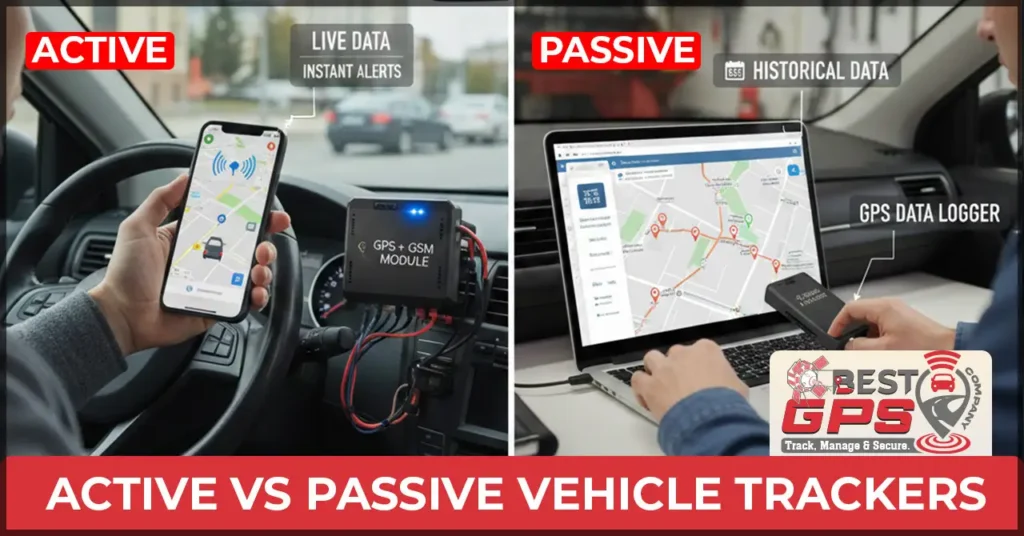
As its name suggests, it is also known as a real-time tracker that sends location and other data to the server or cloud platform instantly. It means you can get the data of fleet operations in real-time using a mobile app or web software. It enables the users to access the location of the fleet at any time and place, with the help of a mobile application.
Reduce Theft, Save More
Contact us for the best GPS Trackers!
How Does It Work?
It works when the tracking device collects GPS signals from the satellite. Then it transmits the data using:
- GSM/GPRS (SIM network),
- Satellite communication, or
- Internet connectivity.
The data then appears on the live dashboard or mobile app within minutes.
Features Of The Active Tracking System
- Live Tracking
- Multiple alerts, including:
- Overspeeding
- Harsh braking
- Route deviation
- Ignition ON/OFF
- Fuel theft or fuel drop
- Geofence entry or exit
- Trip History
- Remote Engine Control
Advantages
- It is best to know live location updates and other data.
- It reduces the chances of vehicle theft and enhances the recovery rate.
- It improves the overall efficiency rate and proper fleet management.
- It helps in monitoring driver behavior and performance.
- It ensures timely delivery and fleet productivity.
- It is ideal for businesses needing data in real-time.
Disadvantages
Although it doesn’t have any disadvantages, from the customer’s perspective, it is considered a little high in cost and needs network coverage for real-time reporting.
What Is A Passive GPS Tracker?
A passive tracker is entirely different from the active one, not in functionalities but in the way it works. It works by storing the tracking data inside the device itself. The primary distinction between the two lies in the fact that it does not relay live updates as the active one does. The information is kept internal and the user will need to take out the device and hook it up to the computer in order to retrieve the information.
How Does It Work?
- The device stores data like movement, speed, history, and route.
- The data is saved within the internal memory.
- Users get data at the end of the trip for analysis.
Key Features
Tracks:
- Distance
- Route taken
- Speed
- Stop duration
- Driving patterns
Works offline without a SIM or internet
Advantages
- It has a lower cost than an active tracker.
- There is no need for the data SIM.
- It is good for historical reporting.
- It works for areas without network signals.
Disadvantages
- It does not offer a live tracking feature.
- There are no instant alerts or notifications.
- It is not useful for theft prevention.
- Data can only be checked after the trip.
Active VS Passive Tracker: A Comparison
| Features | Active Tracking | Passive Tracking |
|---|---|---|
Real-time tracking |
Yes |
No |
Instant alerts |
Yes |
No |
Data storage |
Cloud Storage |
Internal Memory |
Internet / SIM required |
Usually Yes |
No |
Best for business fleets |
Absolutely |
Limited |
Theft prevention |
Excellent |
Very Weak |
Cost |
High |
Low |
Historical data |
Yes, Cloud-based |
Yes, but manual |
Which Type Of Tracker Is Best For Businesses?
The answer is obvious when it comes to delivery vans, cargo, shipments, heavy vehicles, trucks, and fleets. When you are dealing with such assets, an active GPS tracker is the best choice because businesses need:
- Live visibility
- Multiple alerts
- Safety and productivity monitoring
- Fuel management
- Driver scorecards
- Route optimization
- Fleet performance reports
A passive tracker is less suitable for businesses because it does not provide operational control while the trip is in progress.
When Should You Choose An Active Tracker?
Go with the active GPS tracker in situations like:
- You manage a fleet of vehicles.
- You need real-time vehicle tracking.
- Preventing theft is important for you.
- Delays impact your business.
- Wants to monitor drivers in real-time.
- Wants to reduce overall operational cost.
Industries that benefit:
- Transport & logistics
- Delivery services
- Field sales & workforce
- Car rental companies
- Construction & heavy machinery
- Cold chain transportation
- School & college buses
- Emergency services
When To Choose A Passive Tracker?
Passive trackers are a suitable choice when:
- You need the trip record later.
- Vehicles travel in remote areas without coverage.
- Your budget is limited.
- Theft prevention is not your priority.
- Basic trip history is enough.
They are commonly used in:
- Personal vehicles
- Simple mileage logging
- Offline tracking zones
- Compliance reporting
Which One Should You Choose?
It depends on your needs which one you should choose. If you want:
- Control
- Safety
- Efficiency
- Monitoring
- Security
Then choose the active tracking system. Besides this, you can choose the passive tracker if you only need:
- Past trip history
- Basic performance data
- Tracking without connectivity
However, the most in-demand system for businesses nowadays is an active GPS tracking system. Businesses need real-time updates and data to streamline fleet operations, which they can only get from an active GPS tracking system.
Make The Best Decision With Our Guide!
In the market, you will get different options regarding the types, make, and model of GPS devices. Be careful when you are choosing a device for your business no matter it is a large fleet or a small one. It depends on your needs which type you prefer. If you want real-time updates, then go with the active one. If you need data after the trip data not real-time updates, then go with the passive tracker. Both types are good, but their working method are different. Therefore, select the tracker according to your business needs and goals. Make your business operations smooth and efficient with the best GPS tracking system.
Latest Post

A GPS tracker is a growing need for personal vehicles, logistics, fleets, delivery companies, and shipments. With time, the vehicle

Some of the top tracking companies include MuxTech, Car Tracker Company, Best GPS Company, Falcon-i, TPL Tracker, Sky Tack, and

Vehicles are considered valuable assets for every individual. Buying these automobiles costs you a large amount of money. Not only
Call Now
+92 321 917 1616